

Investment case part 6 -
Our success is based on sustainability and a strong corporate culture
Sustainability guides us on what we do and our innovation agenda goes hand-in-hand with our customers’ sustainability agenda. Epiroc has a strong corporate culture with passionate employees, which is our foundation for being an attractive employer and a high-performing organization. Our culture is a competitive advantage.
Accelerate the sustainability transformation
Access to metals and minerals is a prerequisite for modern society to function. Our customers are crucial for providing society with what is needed for a transition to a low-carbon economy. It is, however, evident that operations must be sustainable. Our products and services focused on safety and technological development—are critical to customers´ success, decarbonization of our industry and for accelerating the sustainability transformation. We have a wide range of solutions and services that help our customers improve their safety performance and lower their environmental and climate impact. Automation solutions, electrification, remanufacturing of products and parts for a second life and services are examples of this.
To maintain our innovation leadership, we collaborate with customers, suppliers, and industry leaders to develop more sustainable, safe and low-carbon mining and infrastructure operations. Through innovation, particularly within automation, digitalization, and electrification, we are achieving measurable safety and environmental gains.
Epiroc's contribution to our customers’ decarbonization journey
This illustration exemplifies how our offerings today have the potential to reduce our customers’ CO2e emissions, by using electrification but also in many other ways. Our long-term commitment to offer a full range of emissions-free products, improving the energy performance through product development and compatibility with HVO renewable diesel are also important. We have ambitious 2030 sustainability goals to halve our own Scope 1 and 2 emissions, from transportation and from significant suppliers. This will contribute to lower the upstream CO2e emissions for our customers.

Digitalization
By monitoring energy usage in real time, operations can be optimized to lower both energy consumption and emissions.

Automation
Improving energy efficiency through advanced automation solutions can enable reduced energy consumption.

Electrification
An electrified fleet enables zero tailpipe CO2e emissions and energy savings due to reduced need for ventilation.
Operations
Energy efficiency actions and shift to sea freight transportation enable reduced upstream emissions for customers and lower embodied emissions in products.

Aftermarket
Service
Circular business models (Batteries as a Service, midlife services, remanufacturing solutions, recycling of consumables) enable circulation of products and materials.

Aftermarket
Tools & Attachments
Specialty attachments enable deconstruction and recycling of metals. Rock drilling tools, such as the PCD drill bit, enables energy savings and resource efficiency. Ground engaging tools reduce fuel consumption for mining excavators.
Integrating sustainability
We are committed to integrating sustainability into our strategy and operations. In 2020, we set ambitious sustainability goals for People and Planet for 2030, aligning with the UN Sustainable Development Goals (SDGs) and the Paris Agreement.
Sustainability is integrated in our strategic framework, ensuring that environmental, social, and governance (ESG) considerations are embedded in the decision-making processes. Through the double materiality assessment (DMA) we have identified the environmental, social and governance impacts, risks and opportunities in our operations and our value chain. Our key focus is enhancing the safety of workers in the industries where we are active as well as the transition to a low carbon and circular economy. As a global company, ethical business practices and respect for human rights are fundamental for us. Our governance structure supports the oversight and management of sustainability, ensuring that sustainability is monitored and addressed at the highest levels of the organization. Sustainability strategies, internal guidance tools and activities are in place to reach our goals.
We measure our progress through short-term (1-year) targets and long-term 2030 goals. The results are reported to the Board of Directors and Group Management on a regular basis. Since 2021, sustainability targets have been part of the variable compensation plans for all members of Group Management, including our President and CEO. The outcome for each member is conditional on the tangible progress made towards fulfilling our 2030 sustainability goals.
Epiroc 2030 goals for People and Planet
Safe, healthy, ethical

Safety and health
No work-related injuries

Balanced Workspace
Double the number of women in operational roles*

Walk the talk
Have all employees and
business partners comply with our Code of Conduct
Responsible Sales Assessment Process implemented
Halve CO2e emissions

Operations
Halve CO2e emissions in operations**
90% renewable energy in own operations

Transport
Halve CO2e emissions from transport

Products
Offer a full range of emissions-free*** products
Halve CO2e emissions from machines sold**

Suppliers
Require 50% reduction of CO2e emissions from relevant suppliers
* Based on merit and competence.
*' Validated by the Science Based Targets initiative (SBTi). Baseline year is 2019.
***Emissions-free products do not emit exhaust gas or other pollution from the onboard source of power, also referred to as zero tailpipe emissions.
Environment
The responsible use of resources is an important aspect of our strategy. This involves optimizing energy consumption, circularity, reducing waste, and enhancing the efficiency of products and operations. We have implemented various measures to minimize environmental impact, such as utilizing renewable energy sources, improving energy efficiency, and electrifying our equipment. By leveraging innovative technologies, Epiroc contributes to a reduced environmental footprint for our customers.
About two-thirds of our revenues are derived from aftermarket services and solutions which contribute to prolonging the life of our equipment. With midlife services, retrofit and use of secondary raw materials, we need fewer virgin materials, leading to more sustainable use of resources and facilitating circularity. Midlife services can also include the latest technology, such as automation or electrification upgrades, leading to measurable sustainability gains. Our automation-equipped surface drill rigs enable more energy-efficient operations for our customers, with reduced CO2e emissions. Our specialty attachments, often used for deconstruction and recycling, are also important in enabling more efficient use of resources.
More than 80% of our total CO2e emissions come from the use of sold products. We have therefore set ambitious goals, validated by Science Based Targets initiative (SBTi), to reduce greenhouse gas (GHG) emissions from both our own operations and our value chain. These targets reflect our commitment to mitigating climate-related risks and enhancing the resilience of our business model against future climate challenges. We are however dependent on several external factors, many of which are beyond our direct control, such as global decarbonization, regional policy development and broader market and societal shifts. We aim to offer a full range of emissions-free products by 2030. We reached 43% in 2025. Other solutions will also be needed to reach our climate goals, and some examples are illustrated in Epiroc contribution to our customers` decarbonization journey above.
2025 has been a year focused on further developing our transition plan. In addition to developing our Group transition plan we have also developed divisional transition plans to understand what our prioritized gaps are and what actions we need to take to reach our goals. We have also implemented our internal carbon price during 2025 and it will guide our decision and investments towards lower carbon alternatives going forward. Our 2030 climate targets enable a long-term ambition of net-zero CO2e emissions by 2050 and go hand in hand with EU´s goal of a climate-neutral economy in 2050.
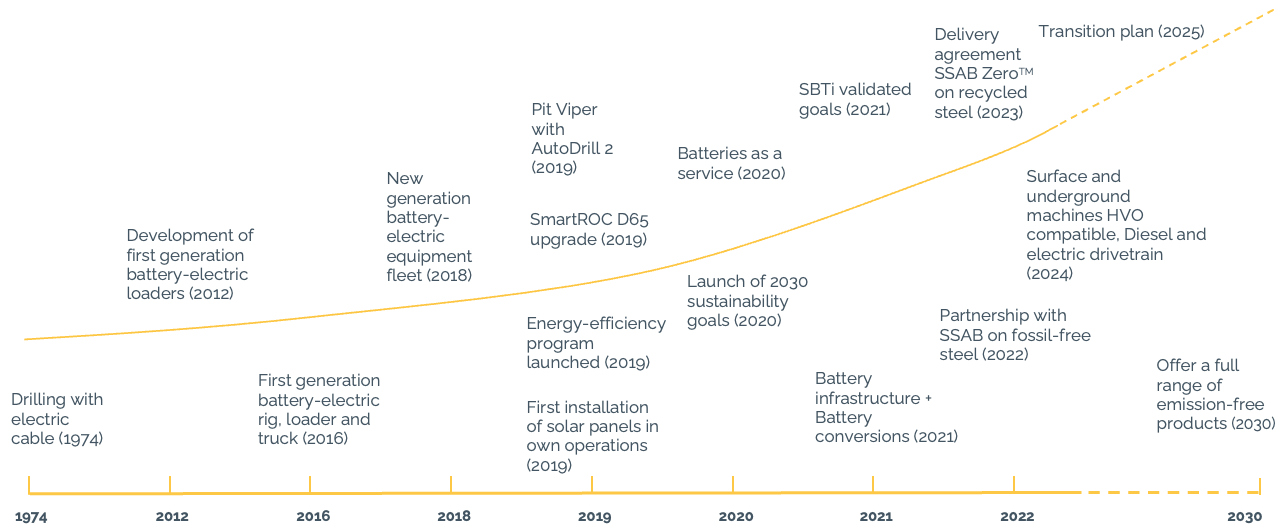
Epiroc's decarbonization journey up to today: selected initiatives
Social
The safety and health of customers and employees are at the forefront of Epiroc's strategic and operational priorities. We have a 2030 goal of no work-related injuries. Comprehensive safety protocols and continuous training programs designed to foster a culture of safety across all operations have been implemented. Moreover, we support occupational health through wellness programs and support systems.
Safety is key for our customers and our equipment is designed with advanced safety features to protect operators and service technicians and reduce accidents. With our Collision Avoidance System Level 9, which is the market’s highest level of collision avoidance system, we can help customers save lives. Epiroc's deployment of battery-electric equipment has also contributed to better working conditions by lowering emissions in the mining and infrastructure sectors.
Epiroc recognizes that our success is driven by passionate and skilled employees within our decentralized organization. All recruitments are based fully on merit and competence, choosing the best candidate for each role. We invest in professional growth through extensive training, leadership development programs, and an inclusive work culture. We are committed to fostering strong leadership within the organization and aim to cultivate a culture of innovation. Our leadership programs are designed to equip leaders with the skills necessary to drive the company's strategic goals and sustainability initiatives. The Sustainability Idea Challenge, which encouraged all employees to submit suggestions for new sustainable solutions, rendered great interest and engagement across the organization.
Epiroc places a high value on diversity and inclusion, recognizing it as important for driving innovation and reflecting the global market we serve. We have set a 2030 goal for a more balanced workforce, implemented policies and practices to promote a diverse and inclusive workplace.


Governance
Epiroc’s customers are located in around 150 countries. In every market where we operate, we act in accordance with applicable laws and regulations. We conduct our business with integrity and uphold high ethical standards. The geographical locations of our sites, suppliers and customers play a central role in identifying risks. Some markets are complex and challenging, and environmental, social and governance related laws and regulations can vary considerably. We have 2030 goals in place to walk the talk. Different programs and processes help us better understand where we may have risks of non-compliance in our whole value chain, also when risks are beyond our direct control.
Epiroc is a signatory to the UN Global Compact, and we incorporate its ten principles on human and labor rights, environment and anti-corruption into our policies and way of operating. In our Code of Conduct (CoC), we have committed to conducting business responsibly in accordance with several international standards, for example the UN Guiding Principles on Business and Human Rights. All Epiroc employees must adhere to our CoC, and our business partners must comply with the Epiroc Business Partner Code of Conduct. We have zero tolerance for corruption. Breaches of the CoC, laws, regulations, or Group policies can be reported in our Speak Up system.
Epiroc strongly believes in respect for human rights across our business operations. We identify and manage these issues through responsible sales assessments and a responsible sourcing process. We work closely with customers and suppliers to ensure they meet the same ethical standards. The company's robust compliance programs include risk identification, policies, training, and digital tools, to manage compliance risks in all countries where we conduct business.
Through our holistic approach to sustainability, innovative technologies, and ethical practices, we demonstrate a robust commitment to accelerating the transformation towards a sustainable and resilient future, aligning our operations with global sustainability standards and contributing to more sustainable mining and infrastructure sectors.
Performance summary (Long-term goals)
| 2030 goal | Base year | Result 2025 | Sustainability Development Goals (SDGs) |
| Offer a full range of emissions-free products. Goal: 100% |
2021: 35% | 43% |


|
|
Halve CO2e emissions from machines sold (SBTi validated). |
2019: 6 871 | 6 430 |
|
| Halve CO2e emissions in operations (SBTi validated). Goal: 48 ktonnes |
2019: 97 | 55 |

|
| 90% renewable energy in operations. Goal: 90% |
2019: 38% | 55% |
|
| Halve CO2e emissions from transport. Goal: 93 ktonnes |
2019: 186 | 141 |
|
| Require 50% reduction of CO2e emissions from relevant suppliers. Goal: 619 ktonnes |
2019: 1 255 | 1 401 |
|
| No work-related injuries. Goal: TRIFR=0 |
2019: 6.0 | 3.9 |

|
| Double the number of women in operational roles (based on merit and competence). Goal: 22% |
2019: 11.2% | 15.7% |

|
| Have all managers sign and comply with our Code of Conduct. Goal: 100% |
2019: 95% | 100% |

|
| Have all significant business partners comply with our Business Partner Code of Conduct. Goal: 100% |
2019: 99% | 98% |
|
| Responsible Sales Assessment Process implemented. Goal: 100% |
2022: 40% | 100% |
|
| Base year emissions for our CO2e emissions reduction goals have been recalculated. Read more about our progress and details about definitions and methodologies in ESRS E1, ESRS S1, ESRS S2, ESRS S3 and ESRS G1. | |||
Transitioning from GRI Standards to the ESRS framework
We have measured our sustainability performance and externally reported progress for many years in accordance with the Global Reporting Initiative (GRI) and other voluntary reporting standards. For the financial year 2025, we report in accordance with the legal requirement in the European Sustainability Reporting Standards (ESRS), EU taxonomy regulation as well as UN Global Compact. Sustainability information is presented in the Sustainability statement.
Other sustainability information, including non-material topics, can be found on the company website.
Community engagement

Water for All
Access to clean water is a human right. Since 1984, Water for All has been Epiroc’s main community‑engagement initiative, funding projects that provide clean drinking water, sanitation, and hygiene—particularly benefiting women and girls. Local Water for All organizations select partners and projects, such as drilling wells, protecting water sources, harvesting rainwater, or building sanitation systems. Water for All is run voluntarily by employees in the Epiroc and Atlas Copco Groups, with employee donations matched two‑to‑one by the companies. More information is available at www.water4all.org.

Bridging the gap between the mining industry and academia
The complexity in mining has highlighted the need to accelerate the implementation of new technologies, such as connectivity, interoperability, automation, digitalization of processes, data analytics, and electrification. As a result, professionals in our industry need to adapt to the new requirements of the mining operations and develop new profiles and skills.
Recognizing these challenges, Epiroc has taken a global initiative to reshape the landscape of mining education in collaboration with academia. One of the most effective formulas to attain educated professionals is the Company-University Chair model. In 2018, Epiroc Iberia started the partnership with a university which in 2021 expanded to also include the Epiroc Andean Region, forming the global Epiroc – University Hub-and-Spokes Network.